
Keywords
insecticide
organophosphorus
poison
suicide
How to Cite
Abstract
Introduction: Poisoning is a significant global public health problem. The appropriate management of poisoning at emergency needs accurate assessment and immediate treatment. The immense chance for better outcomes occurs with early diagnosis and treatment. This study was conducted to assess pattern, management, and outcome of poisoning in tertiary care hospital.
Methods: An observational cross-sectional study was conducted in which records of patients with a diagnosis of poisoning over a period of four years were reviewed.
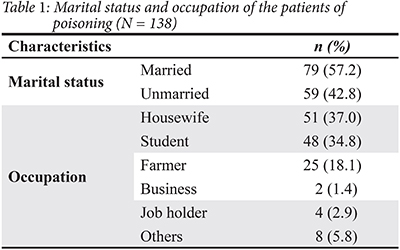
Results: A total of 138 patients were included in the study. A majority (63%) of them were females. Most (67.4%) were managed by general or supportive measure only. Gastric lavage was done in 60% of total patients while 52.9% patients received activated charcoal. Pralidoxime and atropine was received by 51.1% of patients treated with specific antidote. All the antidotes were administered through intravenous route. Regarding outcome, 89.9% were completely recovered. Suicidal poisoning was significantly higher in married as compared to unmarried patients (p = 0.029). Similarly, there was a significant relationship between occupation of the patients and manner of poisoning (p = 0.003). Outcome of treatment had a significant association with the manner of poisoning (p < 0.001). Further analysis revealed that the patients who expired in the hospital were more likely to ingest poison accidentally.
Conclusion: Suicidal poisoning is common and females are more susceptible. Insecticide and rodenticide are the commonly ingested poisons. Treatment outcome of poisoning cases is generally favorable.
References
International programme on Chemical Safety – World Health Organization. Poisoning Prevention and Management [Internet]. WHO; 2014 [cited 2017 Jun 22]. Available from: http://www.who.int/ipcs/poisons/en/
His majesty government, Nepal. Narcotic drug control Act, 2033. 3rd ed. Kathmandu, Nepal: Nepal Law Commission; 2049. Available from: http://www.lawcommission.gov.np/documents/2015/08/%e0%a4%b2%e0%a4%be%e0%a4%97%e0%a5%81-%e0%a4%94%e0%a4%b7%e0%a4%a7-%e0%a4%a8%e0%a4%bf%e0%a4%af%e0%a4%a8%e0%a5%8d%e0%a4%a4%e0%a5%8d%e0%a4%b0%e0%a4%a3-%e0%a4%90%e0%a4%a8-%e0%a5%a8%e0%a5%a6%e0%a5%a9.pdf
Pesticide Committee. Pesticide Act, 2048 (1991). Kathmandu, Nepal: Nepal Law Codmmission; 1991. Available from: www.spsenquiry.gov.np/downloadfile/pesticides-act_1304936385_1483432035.pdf.
Adinew GM, Woredekal AT, DeVos EL, Birru EM, Abdulwahib MB. Poisoning cases and their management in emergency centres of government hospitals in northwest Ethiopia. African Journal of Emergency Medicine. 2017;7(2):74-78. DOI: https://doi.org/10.1016/j.afjem.2017.04.005
Wakushie J, Fekede BD. Pattern of acute poisoning and management outcome among patients presented to Adama referral hospital, Ethiopia. Medical Data. 2016;8(3):185-189. Available from http://www.md-medicaldata.com/godina_2016_broj_3_title_07.html
Nair PK, Revi NG. One-year study on pattern of acute pharmaceutical and chemical poisoning cases admitted to a tertiary care hospital in Thrissur, India. Asia Pacific Journal of Medical Toxicology. 2015;4(2):79-82. Available from https://www.semanticscholar.org/paper/One-Year-Study-on-Pattern-of-Acute-Pharmaceutical-a-NAIR-GOPALAN/49425ce34f49a1125f4bddf911092d784de741db
Patil A, Peddawad R, Verma VCS, Gandhi H. Profile of acute poisoning cases treated in a tertiary care hospital: A study in Navi Mumbai. Asia Pacific Journal of Medical Toxicology. 2014;3(1):36-40. Available from https://www.researchgate.net/publication/295694958_Profile_of_Acute_poisoning_cases_treated_in_a_Tertiary_Care_Hospital_-_A_study_in_Navi_Mumbai
V A, Bedwal A, Rajarathna K, M NS. Pattern and pharmacotherapy of acute poisonings presenting to a tertiary care centre. International Journal of Basic and Clinical Pharmacology. 2017;6(4):879. DOI: https://doi.org/10.18203/2319-2003.ijbcp20171097
Chen F, Wen J-P, Wang X-P, Lin Q-M, Lin C-J. Epidemiology and characteristics of acute poisoning treated at an emergency center. World J Emerg Med. 2010;1(2):154-156. PMID: https://www.ncbi.nlm.nih.gov/pubmed/25214960
Mbarouk GS, Sawe HR, Mfinanga JA, Stein J, Levin S, Mwafongo V, et al. Patients with acute poisoning presenting to an urban emergency department of a tertiary hospital in Tanzania. BMC Res Notes. 2017;10(1):482. PMID: https://www.ncbi.nlm.nih.gov/pubmed/28915823 DOI: https://doi.org/10.1186/s13104-017-2807-2
Kishore PV, Palaian S, Paudel R, Mishra D, Ojha P, Alam K, et al. Pattern of poisoning cases in a teaching hospital in Western Nepal. Journal of Institute of Medicine. 2008;30(1):26-34. Available from https://www.nepjol.info/index.php/JIOM/article/view/1374
Shanmugam S, Wilson NA. Study on management of various poisoning cases at a tertiary care teaching hospital. International Journal of Pharmacology and Toxicology. 2016;4(2):220-223. DOI: https://doi.org/10.14419/ijpt.v4i2.6712
Shakya RP, Adhikary S, Bajracharya R. Pattern of Acute Poisoning Attending a Tertiary Care Hospital of Western Nepal. Journal of Lumbini Medical College. 2016;4(2):90. DOI: https://doi.org/10.22502/jlmc.v4i2.98
Maheswari E, Abraham L, Chacko C, Saraswathy G, Ramesh A. Assessment of Pattern, Severity and Outcome of Poisoning in Emergency Care Unit. Journal of Applied Pharmaceutical Science. 2016;6(12):178-183. DOI: https://doi.org/10.7324/JAPS.2016.601225
Asari PD, Shah SM, Amin AJ, Patel ND. Drug Utilization Study on Acute Poisoning Cases Treated at a Tertiary Care Hospital in Western Part of India. Asia Pacific Journal of Medical Toxicology. 2016;5(1):20-24. DOI: https://doi.org/10.22038/apjmt.2016.6881
Z’gambo J, Siulapwa Y, Michelo C. Pattern of acute poisoning at two urban referral hospitals in Lusaka, Zambia. BMC Emerg Med. 2016;16:2-8. PMID: https://www.ncbi.nlm.nih.gov/pubmed/26748777 DOI: https://doi.org/10.1186/s12873-016-0068-3
Acharya S, K L, M S. Assessment of Poisoning Cases in a Tertiary Care Hospital. International Journal of Biomedical Research. 2014;5(9):578-581. DOI: https://doi.org/10.7439/ijbr.v5i9.773
Paudyal BP. Poisoning : pattern and profile of admitted cases in a hospital in central Nepal. JNMA J Nepal Med Assoc. 2005;44(159):92-96. PMID: https://www.ncbi.nlm.nih.gov/pubmed/16554862
- The Journal of Lumbini Medical College (JLMC) publishes open access articles under the terms of the Creative Commons Attribution (CC BY) License which permits use, distribution and reproduction in any medium, provided the original work is properly cited.
- JLMC requires an exclusive license to publish the article first in its journal in print and online.
- The corresponding author should read and agree to the following statement before submission of the manuscript for publication,
- License agreement
- In submitting an article to Journal of Lumbini Medical College (JLMC) I certify that:
- I am authorized by my co-authors to enter into these arrangements.
- I warrant, on behalf of myself and my co-authors, that:
- the article is original, has not been formally published in any other peer-reviewed journal, is not under consideration by any other journal and does not infringe any existing copyright or any other third-party rights;
- I am/we are the sole author(s) of the article and have full authority to enter into this agreement and in granting rights to JLMC are not in breach of any other obligation;
- the article contains nothing that is unlawful, libelous, or which would, if published, constitute a breach of contract or of confidence or of commitment given to secrecy;
- I/we have taken due care to ensure the integrity of the article. To my/our - and currently accepted scientific - knowledge all statements contained in it purporting to be facts are true and any formula or instruction contained in the article will not, if followed accurately, cause any injury, illness or damage to the user.
- I, and all co-authors, agree that the article, if editorially accepted for publication, shall be licensed under the Creative Commons Attribution License 4.0. If the law requires that the article be published in the public domain, I/we will notify JLMC at the time of submission, and in such cases the article shall be released under the Creative Commons 1.0 Public Domain Dedication waiver. For the avoidance of doubt it is stated that sections 1 and 2 of this license agreement shall apply and prevail regardless of whether the article is published under Creative Commons Attribution License 4.0 or the Creative Commons 1.0 Public Domain Dedication waiver.
- I, and all co-authors, agree that, if the article is editorially accepted for publication in JLMC, data included in the article shall be made available under the Creative Commons 1.0 Public Domain Dedication waiver, unless otherwise stated. For the avoidance of doubt it is stated that sections 1, 2, and 3 of this license agreement shall apply and prevail.
Please visit Creative Commons web page for details of the terms.