
Keywords
Obesity
Overweight
Pregnancy outcomes
How to Cite
Abstract
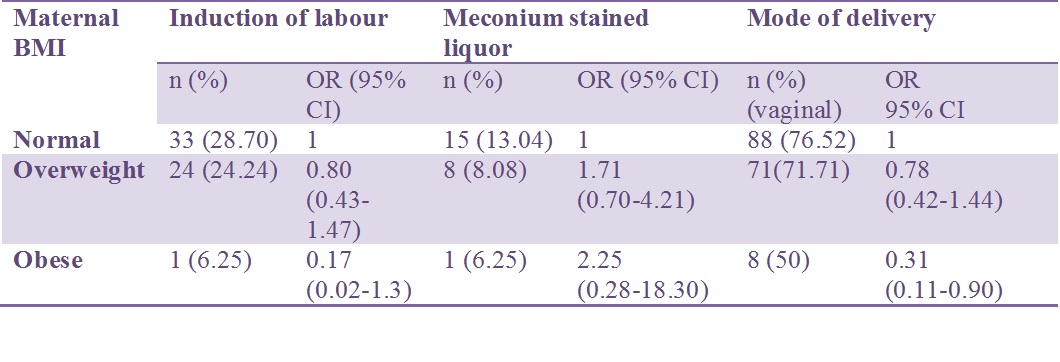
Introduction: Maternal obesity is an established risk factor for various adverse pregnancy outcomes. Increased chances of labour induction, prolonged labour, instrumental and cesarean deliveries, medical disorders of pregnancy, post partum haemorrhage, preterm deliveries, macrosomia, low Apgar score etc. are well recognised risks of maternal obesity. This study aimed to evaluate these maternal and fetal outcomes in relation to the body mass index (BMI) of parturients. Methods: A prospective cohort study involving 115 overweight and obese women was conducted. Various maternal and fetal outcomes were studied and compared with those of 115 postpartum women with normal BMI. Statistical analysis was done using student's t-test and Chi square test. Binomial logistic regression analysis was carried out to examine the magnitude and significance of the independent effect of BMI. Results: The three groups were comparable in terms of maternal age and gestational age at delivery. The total blood loss was significantly higher in the obese group as compared to the normal BMI (p=0.001) or overweight groups (p=0.005). Vaginal delivery was 69% less common in obese group in comparison to normal BMI group. The prevalence of meconium stained liquor, labour induction, preterm labour, and admission to neonatal intensive care unit were not significantly different across the three groups. Conclusion: This study highlighted the increased risk of total blood loss and birth weight >3500 grams with increasing BMI of pregnant women. A multicentric prospective study with larger sample size would shed further light on the strength of association between maternal BMI and various outcomes.
References
World Health Organization. Obesity and Overweight [Internet]. Geneva, Switzerland: WHO, 2021. [Accessed on 15 Oct 2021] Available from: https://www.who.int/news-room/fact-sheets/detail/obesity-and-overweight
Swinburn BA, Sacks G, Hall KD, McPherson K, Finegood DT, Moodie ML, et al. The global obesity pandemic: Shaped by global drivers and local environments. Lancet. 2011;378(9793):804-14. PMID: 21872749 DOI: https://doi.org/10.1016/S0140-6736(11)60813-1
Ministry of Health Nepal, New ERA, ICF. Nepal Demographic and Health Survey 2016 [Internet]. Kathmandu, Nepal: Ministry of Health, 2017. [Accessed on 14 Oct 2021] Available from: https://www.dhsprogram.com/pubs/pdf/fr336/fr336.pdf
Usha Kira TS, Hemmadi S, Bethel J, Evans J. Outcome of pregnancy in a woman with an increased body mass index. BJOG. 2005;112(6):768-72. PMID: 15924535 DOI: https://doi.org/10.1111/j.1471-0528.2004.00546.x
Schrauwers C, Dekkra G. Maternal and perinatal outcome in obese pregnant patients. J Matern Fetal Neonatal Med. 2009;22(3):218-26. PMID: 19330705 DOI: https://pubmed.ncbi.nlm.nih.gov/19330705/
Manzanares SG, Santallaa HA, Vicoa ZI, Criadoa MSL, Pineda LA, Galloa VJL. Abnormal maternal body mass index and obstetric and neonatal outcome. J Matern Fetal Neonatal Med. 2012;25(3):308-12. PMID: 21615231 DOI: https://doi.org/10.3109/14767058.2011.575905
Nohr EA, Vaeth M, Baker JL, Sørensen TIa, Olsen J, Rasmussen KM. Combined association of prepregnancy body mass index and gestational weight gain with the outcome of pregnancy. Am J Clin Nutr. 2008;87(6):1750-9. PMID: 18541565 DOI: https://doi.org/10.1093/ajcn/87.6.1750
Tenant PWG, Rankin J, Bell R. Maternal body mass index and the risk of fetal and infant death: a cohort study from the North of England. Hum Reprod. 2011;26(6):1501-11. PMID: 21467206 DOI: https://doi.org/10.1093/humrep/der052
Persson M, Johansson S, Villamor E, Cnattingius S. Maternal overweight and obesity and risks of severe birth-asphyxia-related complications in term infants: a population-based cohort Study in Sweden. PLoS Med. 2014;11(5):e1001648. PMID: 24845218 DOI: https://doi.org/10.1371/journal.pmed.1001648
Ojha N. Pregnancy outcome in overweight and obese mothers at a tertiary care hospital. Journal of Institute of Medicine. 2016;38(2/3):56-62. Available from:
World Health Organization. Obesity: Preventing and managing the global epidemic. Geneva, Switzerland: World Health Organization. Report number: WHO Technical Report Series 894, 2000. Available from: https://apps.who.int/iris/handle/10665/42330
O’Dwyer V, O’Kelly S, Monaghan B, Rowan A, Farah N, Turner MJ, et al. Maternal obesity and induction of labor. Acta Obstet Gynecol Scand. 2013;92(12):1414-8. PMID: 24116732 DOI: https://doi.org/10.1111/aogs.12263
Vinturache AE, McDonald S, Slater D, Tough S. Perinatal outcomes of maternal overweight and obesity in term infants: a population-based cohort study in Canada. 2015;5(0):9334. PMID: 25791339 DOI: https://doi.org/10.1038/srep09334
- The Journal of Lumbini Medical College (JLMC) publishes open access articles under the terms of the Creative Commons Attribution (CC BY) License which permits use, distribution and reproduction in any medium, provided the original work is properly cited.
- JLMC requires an exclusive license to publish the article first in its journal in print and online.
- The corresponding author should read and agree to the following statement before submission of the manuscript for publication,
- License agreement
- In submitting an article to Journal of Lumbini Medical College (JLMC) I certify that:
- I am authorized by my co-authors to enter into these arrangements.
- I warrant, on behalf of myself and my co-authors, that:
- the article is original, has not been formally published in any other peer-reviewed journal, is not under consideration by any other journal and does not infringe any existing copyright or any other third-party rights;
- I am/we are the sole author(s) of the article and have full authority to enter into this agreement and in granting rights to JLMC are not in breach of any other obligation;
- the article contains nothing that is unlawful, libelous, or which would, if published, constitute a breach of contract or of confidence or of commitment given to secrecy;
- I/we have taken due care to ensure the integrity of the article. To my/our - and currently accepted scientific - knowledge all statements contained in it purporting to be facts are true and any formula or instruction contained in the article will not, if followed accurately, cause any injury, illness or damage to the user.
- I, and all co-authors, agree that the article, if editorially accepted for publication, shall be licensed under the Creative Commons Attribution License 4.0. If the law requires that the article be published in the public domain, I/we will notify JLMC at the time of submission, and in such cases the article shall be released under the Creative Commons 1.0 Public Domain Dedication waiver. For the avoidance of doubt it is stated that sections 1 and 2 of this license agreement shall apply and prevail regardless of whether the article is published under Creative Commons Attribution License 4.0 or the Creative Commons 1.0 Public Domain Dedication waiver.
- I, and all co-authors, agree that, if the article is editorially accepted for publication in JLMC, data included in the article shall be made available under the Creative Commons 1.0 Public Domain Dedication waiver, unless otherwise stated. For the avoidance of doubt it is stated that sections 1, 2, and 3 of this license agreement shall apply and prevail.
Please visit Creative Commons web page for details of the terms.